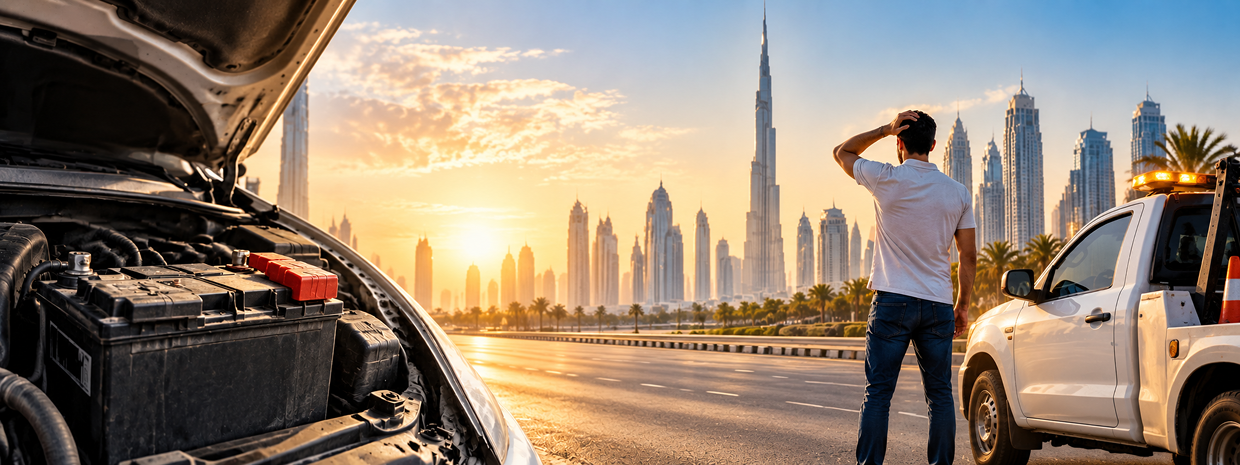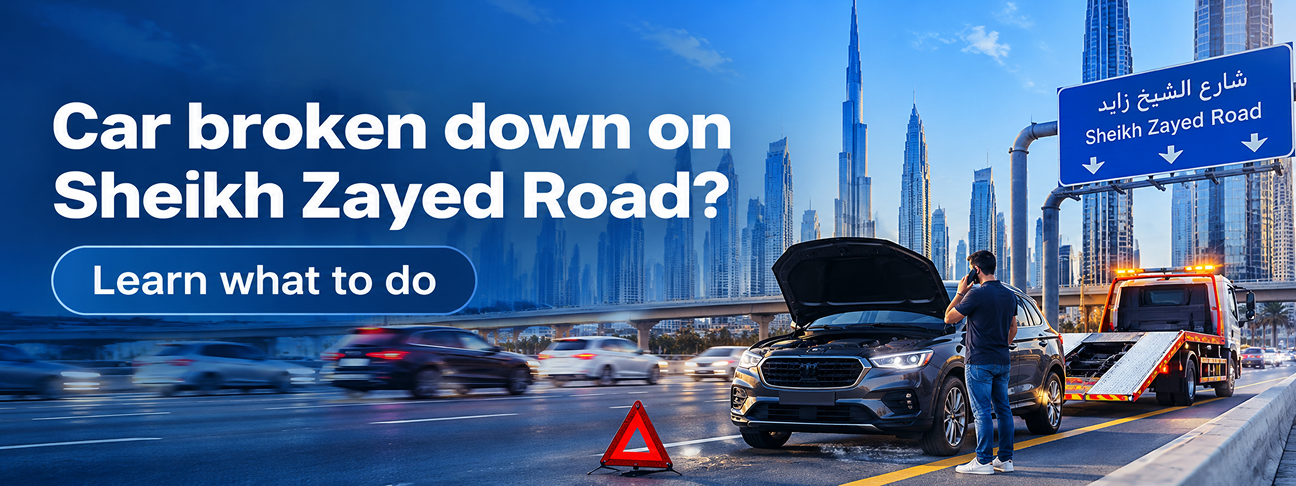
Your dashboard lights up. The engine dies. You’re on Sheikh Zayed Road. Traffic flows fast in every direction. What do you do now? If your car breaks down on Sheikh Zayed Road, the first two minutes are critical. They decide if this is a breakdown or turns into a crash. In 2026 Dubai Police say stopping in a live lane is one of the most dangerous things a driver can do.
This guide gives you steps to follow: from the moment your car starts losing power to the moment the towing service arrives and you’re back on your way. Do not panic. Stay calm. Act fast.
- First keep your hands on the wheel. Keep your eyes on the road. Do not slam on the brakes. Avoid movements. Your car may still be in motion.
- Next if you can turn on your hazard lights. If the lights don’t work, use your phone or a warning triangle if you have one. Make sure other drivers see you.
- Then try to move the vehicle to the shoulder. Only if it’s safe. Only if you can. If you’re in a traffic lane do not. Turn the wheel. Do not get out. Do not walk across lanes.
If you can’t move the car stay inside. Close the windows. Lock the doors. Keep your seatbelt on. The road is dangerous. The cars are going fast.
Now call for help. Use your phone. Dial the emergency number. Dubai Police, traffic control or your roadside assistance. Give your location. Be clear. Be calm.
What Should You Do the Moment Your Car Starts Failing?
In 2026, Dubai Police’s Traffic Department told drivers that a vehicle in trouble should be taken towards the nearest exit, and that 999 should be called straight away if it can’t move (Khaleej Times, July 2026). Most breakdowns give you a few seconds of warning. Use them to get out of the fast lanes, not to diagnose the problem.
Here’s the order that matters:
- Switch on your hazard lights immediately. Do it before you brake or change lanes so drivers behind you get the message early.
- Signal and move right. Work your way across, one lane at a time, towards the right-hand hard shoulder. Check mirrors each time.
- Aim for an exit if you still have momentum. A slip road or service road is far safer than the hard shoulder of a highway this busy.
- Stop as far right as you can. Turn your wheels away from traffic and apply the handbrake.
Thomas Edelmann, founder of RoadSafety UAE, has made a useful point here. He argues that a moving car rarely dies in a split second; there’s almost always some warning (Gulf News, 2017). That’s why acting on the first warning sign matters more than anything you do after you’ve stopped.
Our take: Most drivers lose those warning seconds because they slow down in their current lane to “see what’s wrong.” On Sheikh Zayed Road, slowing in lane two or three is the dangerous part. Move first. Diagnose later, from behind a barrier.
Why Is a Breakdown on Sheikh Zayed Road So Dangerous?
The E11 is the road in the UAE. In Dubai it is known as Sheikh Zayed Road. According to the Khaleej Times and a report on speed limits in the UAE in 2025 this road carries a lot of fast-moving traffic in multiple lanes. When a car stops suddenly in a lane drivers behind have very little time to react. In 2021 Dubai Police issued fines to 11,565 motorists for stopping abruptly on the road. That number shows how common this behavior is.
These stops are not harmless. The same 2021 data linked stops to 11 accidents. Among them eight people lost their lives. 21 Were injured. These numbers are not isolated. Earlier data shows a trend. Dubai Police reported 13 deaths and 23 injuries caused by vehicles stopping on the road in 2016. The Gulf News covered this in 2017.
Recent events show the danger remains real. In June 2026 seven people. Nine were injured on Emirates Road after a minibus collided with a truck that had stopped in the middle of the road. This incident was reported by Aletihad. In mid-2026 another serious crash happened on Jebel Ali Road. A bus stopped in a lane due, to a technical fault. Twenty-five people were hurt. That report came from the Khaleej Times in July 2026.
Recently a motorcyclist was seriously injured on Sheikh Mohammed bin Zayed Road. The accident happened when the motorcyclist hit a truck that had broken down in the middle of the highway. This was reported by the Gulf News.
Sheikh Zayed Road was not the scene of any of these three incidents.. The conditions are the same. The roads are fast. Traffic is heavy. Vehicles stop where drivers do not expect them to. The risk is real. It is growing. One sudden stop can change everything.
How Do You Make the Scene Safe Once You’ve Stopped?
In 2026, Dubai Police’s Director of Traffic, Brigadier Jumaa Salem bin Suwaidan, set out the steps for an immobile vehicle: hazard lights on, protect the driver and passengers first, place a warning triangle behind the car, leave the vehicle, move away from the road, then call the police (Aletihad, June 2026). Here’s how that looks in practice.
Hazard Lights and Warning Triangle
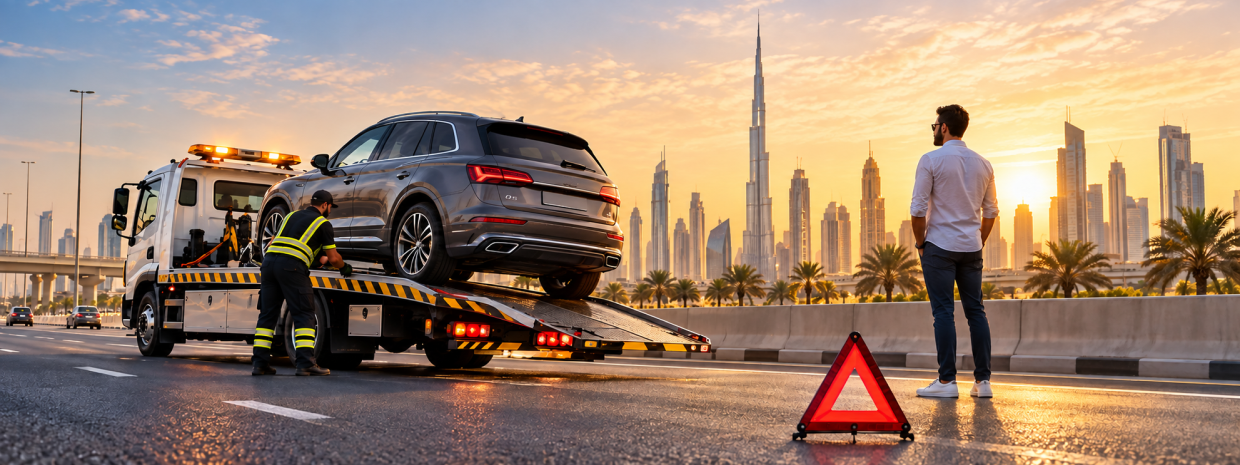
Keep your hazards flashing the whole time. RoadSafetyUAE advises placing a reflective triangle at least 100 metres behind the car, on the same side of the road (Khaleej Times, July 2026). Only do this if you can walk there without stepping into traffic. If it isn’t safe, skip it. Your life is worth more than the triangle.
Get Everyone Out and Away From the Car
Should you stay inside with the AC running? It’s tempting in Dubai heat, but no. Dubai Police’s guidance is to leave the vehicle and move to a safe area away from the road (Aletihad, June 2026). Exit on the side away from traffic. Get behind the crash barrier if there is one.
- Don’t stand between your car and oncoming traffic (RoadSafetyUAE, via Khaleej Times, 2026).
- Don’t stand in front of or behind the car either.
- Keep children and pets with you and away from the road edge.
- Take water, your phone and your ID.
Don’t Try a Roadside Repair
A former Dubai Police traffic director said it clearly in 2017: if your car has a mechanical problem don’t go under the car to fix it. Instead call a towing company. (Gulf News, 2017). Trying to change a tire or look under the bonnet on the shoulder of Sheikh Zayed Road can be extremely dangerous. You’re inches from traffic moving at high speed. Let professionals handle it. Use roadside assistance Dubai or a car recovery team.
In 2026 Dubai Police updated their guidance for drivers whose cars can’t move. The advice has five steps: turn on hazard lights make sure the driver and passengers are safe place a warning triangle behind the vehicle get to a safe area away, from traffic and contact the police. (Aletihad, June 2026).
Who Should You Call: 999, 901 or a Towing Service?
Dubai Police operate 999 for emergencies and 901 as a non-emergency line that handles vehicle breakdowns and minor accidents (Gulf News, 2022). Which one you dial depends on where your car ended up. Most drivers will need two calls: one to the police if the car is a hazard, and one for emergency towing Dubai to actually move it.
| Your situation | Who to call |
| Car stuck in a live lane, can’t be moved | 999 immediately |
| Anyone injured, or there’s smoke or fire | 999 |
| Car safely on the hard shoulder or off the road | 901 for police support if needed, plus a towing service |
| Rental or leased car | Your rental company’s breakdown line, then follow their instructions |
| Car insurance includes roadside assistance | Your insurer’s assistance number |
Not sure if your insurance covers towing? Gulf News suggests talking to your insurance company to find out if the policy has assistance for breakdowns and towing (Gulf News, 2022). It’s an idea to check before you need it.
What to Say to the Tow Truck Operator?
Sheikh Zayed Road goes in two directions with lanes, service roads and interchanges. Saying “I’m on Sheikh Zayed Road” is not enough for a tow truck to find you fast. Give them:
Direction of travel: going towards Abu Dhabi or going towards Sharjah or Deira.
Nearest landmark or interchange: look at the overhead sign exit number, metro station or building.
Where the car is: on the shoulder, on the service road or (if it has to be) which lane.
- Your car: the make, model, color and license plate number.
- What happened: the car won’t start it overheated it has a tire there was accident damage or there is a warning light.
- Whether it rolls: if the wheels are locked or damaged a flatbed tow truck is usually needed. Better send your live GPS location instead of explaining it. That takes away all the guesswork.
How Much Is the Fine for Stopping on Sheikh Zayed Road?
In 2026 Dubai Police said that parking in the middle of the road is not allowed. This includes situations like a car breaking down running out of fuel or having a tire. The penalty for this is a fine of AED 1,000 and six points on the drivers license. There is also an AED 500 charge if the stop causes traffic to be blocked. This extra fee is based on Article 98. The total cost for one stop could be as high, as AED 1,500.
| Violation | Penalty |
| Stopping in the middle of the road | AED 1,000 + 6 black points |
| Obstructing traffic flow (Article 98) | Additional AED 500 |
The law is aimed at stopping without justification. So if a genuine breakdown is handled correctly that is a case, from pulling over in a live lane to make a phone call. The safest way to protect yourself both physically is to move to the hard shoulder or an exit whenever the car allows it and to call 999 immediately if it does not.
Wondering what causes a car breakdown Dubai in the first place? Dubai Police’s traffic department has listed faulty batteries, damaged tyres or wheels, electrical problems and misfuelling among the most common causes (Gulf News, 2020). Most of these give warning signs days in advance.
What Happens When the Tow Truck Arrives?
Once you’ve called a towing service, stay behind the barrier until the truck has stopped and the operator signals it’s safe to approach. A professional operator will secure the scene behind your car, check whether the vehicle can roll, and decide between a wheel-lift tow or a flatbed. If the car was damaged in a collision, expect an accident recovery or vehicle recovery job rather than a standard tow. Dubai Police has stressed that patrols will secure a stuck vehicle to protect passengers and other road users, so if police are already on site, follow their instructions first (Khaleej Times).
Before your car is loaded:
- Agree the drop-off point. Your home, a garage, or your dealer’s service centre.
- Confirm the price before the job starts.
- Take photos of your car from all sides, for your records and any insurance claim.
- Remove valuables and anything you’ll need overnight.
- Ask how you’ll travel. Check whether you can ride along or need a taxi.
A practical tip: If your car broke down in the outer lanes and was moved by police patrol, it may be parked somewhere different from where it stopped. Ask the officer for the exact location before calling for car recovery, so the tow truck goes to the right spot.
Need a Tow on Sheikh Zayed Road?
CarTow provides 24/7 towing and roadside assistance across Dubai and the wider UAE. Share your location, request a tow, and track the CarTow Captain heading to you in real time. Support is available in English, Arabic, Hindi and Urdu. Call or WhatsApp +971 54 449 2987, or book through the CarTow app.
Frequently Asked Questions (Information about Car towing Dubai)
What should I do if my car breaks down on Sheikh Zayed Road?
Turn on your hazards and move to the right-hand hard shoulder or nearest exit if the car still rolls. Place a warning triangle behind it if safe, get everyone out and behind the barrier, then call for a tow. Dubai Police fine stopping in a live lane AED 1,000 and six black points (Gulf News, 2026).
Should I call 999 or 901 if my car breaks down in Dubai?
Call 999 if your car is stuck in a live lane, anyone is hurt, or there’s smoke or fire. Dubai Police instruct drivers whose vehicles are immobile to call 999 immediately (Khaleej Times, 2026). If you’re safely on the hard shoulder, 901 is Dubai Police’s non-emergency line for breakdowns and minor accidents.
Is it safe to wait inside my car on the hard shoulder?
No. Dubai Police advise drivers to leave the vehicle and move to a safe place away from the road (Aletihad, 2026). Parked cars on hard shoulders can still be hit. Exit on the side away from traffic, stand behind the barrier if there is one, and never between your car and oncoming vehicles.
How far behind my car should I place the warning triangle?
RoadSafetyUAE recommends placing a reflective warning triangle at least 100 metres behind the car, on the same side of the road (Khaleej Times, 2026). Only walk back to place it if you can stay well clear of passing traffic. If that isn’t possible on a busy stretch, keep your hazards on and skip it.
Will I be fined if my car breaks down on the road?
Stopping in the middle of the road carries an AED 1,000 fine and six black points, plus AED 500 for obstruction under Article 98 (Gulf News, 2026). The rule targets unjustified stops. Moving to the hard shoulder or an exit whenever possible, and calling 999 if you can’t, is the safest way to handle a genuine breakdown.
Conclusion
A breakdown on Sheikh Zayed Road is stressful, but the steps are simple once you know them:
- Move right and get off the live lanes at the first sign of trouble.
- Hazards on, triangle out (only if safe), everyone out and behind the barrier.
- Call 999 if the car is stuck in a lane or anyone’s hurt; 901 for non-emergency police support.
- Call a towing service Dubai with your exact direction, landmark and live location.
- Never attempt a roadside repair on a highway this busy.
Save a 24/7 towing number in your phone today, so you’re not searching “tow truck near me” or “car recovery Dubai” from the hard shoulder.